
News All News
July 31st, 2026
Games as Design Research
How faculty, students, and practitioners use play to generate knowledge, engage communities, and rethink urban design
By A. Krista Sykes
Published in Harvard Design Magazine
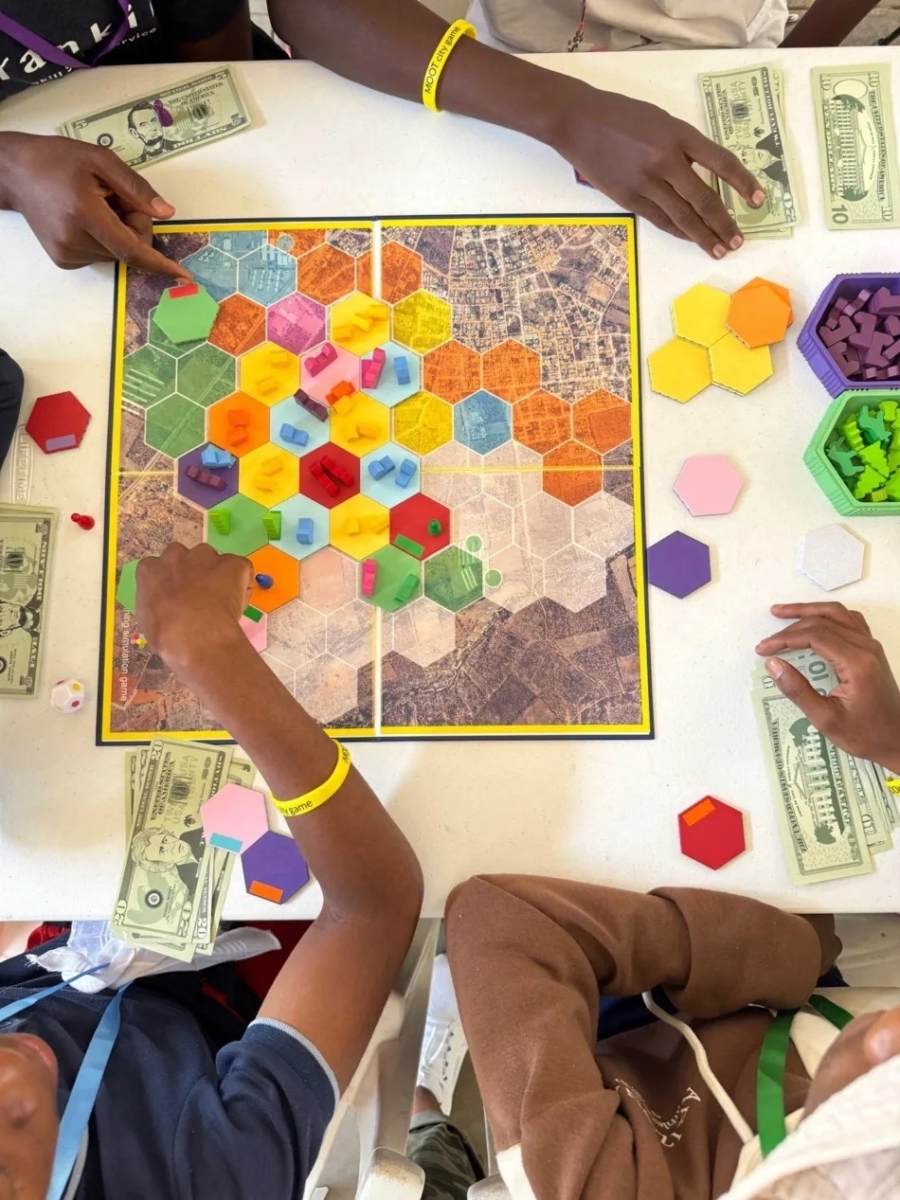
Developed during Kgafela’s doctoral research at the GSD, MOOT City began as a prototype of a board game exploring how civic imagination and experiential learning can deepen public understanding of policymaking. Since then, it has been used in classrooms, community centers, and public workshops to facilitate discussion of issues including housing, equity, and governance. The project continues to evolve as a tool for civic learning and public engagement. Photo: Gorata Kgafela
A group of strangers gathers around a colorful board game in a Botswanan mall. Within minutes, they are debating affordable housing, green space, and economic development. One player laughs and accuses another of being “an elitist” because they placed high-income housing far from low-income neighborhoods. Others argue over where to locate a transit hub. No one is offended. No one storms out. They are simply playing MOOT City, an urban planning game developed by Harvard Graduate School of Design (GSD) alumna Gorata Kgafela.
Yet the questions the players wrestle with are the same ones that confront planners, architects, public officials, developers, and community members every day.
Games offer something conventional design media rarely can: rather than merely represent buildings, neighborhoods, or systems, they invite people to inhabit them. Players negotiate competing priorities, test ideas, confront tradeoffs, and experience the consequences of their decisions. In the process, abstract concepts become tangible, and participation replaces observation.
Across the Harvard GSD, faculty and students are using games to explore the complex forces that shape cities—and to extend design conversations beyond Gund Hall. Their projects engage communities in planning, preserve local histories, and create new forms of civic participation, while practitioners use similar methods to address issues such as climate adaptation, development, and public decision-making. Together, these efforts signal a broader shift toward games as a medium of inquiry—one that invites wider public involvement while revealing the social, political, and economic networks that structure the built environment.
Read the full article on Harvard Design Magazine here.
Tags: Harvard startups, GSD, Harvard Graduate School of Design, urban planning, board game, civic engagement
Press Contact: Kirsten Mabry | (617) 495-4157